Quick Answer: You don’t need a coding background, a CS degree, or prior IT experience to how to become a Data Analyst in Pune. What you need is the right set of tools (SQL, Excel, Power BI, Python basics), 3–5 real projects to show employers, and structured training that prepares you for interviews — not just certificates. Most beginners become job-ready in 4–6 months.
The Belief That’s Stopping Most People
Every week, people walk into our center in Pune with the same quiet fear.
“I’m from a commerce background—is data analytics even possible for me?”
“I did my BCA but never really learned coding properly. Is it too late?”
“I’ve been working in operations for three years. Can I really switch to data?”
The answer to all three is the same: yes. But the fear is understandable—because most content online about becoming a Data Analyst is written for people who already have some technical foundation.
This guide isn’t.
This is written specifically for someone who is starting from scratch — a fresh graduate, a non-IT professional, a commerce or arts student, a working person in their late 20s who wants a better career trajectory. If that’s you, read this carefully. Because the path is real, it’s structured, and it’s more accessible than most people realise.
What “No Experience” Actually Means to a Recruiter
Here’s something that most guides get completely wrong.
When recruiters say they want “experience,” they don’t mean years on a payroll. They mean proof that you can work with data. Those are genuinely different things — and understanding that difference changes everything about how you approach your job search.
A fresher who has:
- Built a sales performance dashboard in Power BI from a real dataset
- Written SQL queries to answer actual business questions
- Done a Python project that cleaned and analysed customer data
- Pushed all of this to a documented GitHub portfolio
…that fresher has “experience” in the way that actually matters to a hiring manager. They can see you work. They can evaluate your thinking. They have something concrete to ask you about in an interview.
A fresher who spent 6 months watching YouTube tutorials and collecting online certificates — but never built anything — has none of that. Despite technically “learning” the same material.
This is the most important mindset shift to make at the beginning: experience in data analytics is what you build, not what you’re given.
Who Can Become a Data Analyst in Pune?
Let’s be direct about this. The following backgrounds all lead to successful data analyst careers—we’ve seen each of these in our own batches at Unique System Skills India:
B.Com / BBA / BA graduates—Business intuition and communication skills are genuine advantages in data roles. Many companies prefer analysts who understand business context, not just code.
BCA / BSc IT students—You have some technical exposure already. Data Analytics fills the practical skills gap that college curricula consistently leave open.
Engineering freshers (non-CS)—Mechanical, Civil, and Electrical engineers increasingly move into analytics. Your logical thinking transfers directly.
Working professionals from operations, sales, finance, or HR—domain knowledge is a career asset in data analytics. A finance professional who learns SQL and Power BI becomes a uniquely valuable analyst for BFSI companies.
MCA / MSc students—Strong academic foundation, often just needs practical tool training and project direction.
Career switchers in their late 20s or early 30s—This is more common than people admit. Pune’s IT ecosystem actively hires people who bring domain experience alongside new data skills.
The one honest prerequisite: basic English reading ability and the willingness to practice consistently. That’s it. No prior coding. No maths beyond school-level statistics. No IT background required.
If you’re still weighing which IT career fits your background best, our detailed guide on best courses for non-IT freshers to start a career in IT gives a clear framework based on your degree and goals.
What Does a Data Analyst Actually Do Day-to-Day?
Before committing to a career, it’s worth knowing what you’re actually signing up for. Not the job description version — the real version.
A typical day for a Data Analyst at a Pune-based company looks something like this:
Morning: Pull a dataset from the database using SQL. Check for inconsistencies — missing values, duplicates, format errors. Clean it.
Mid-morning: Update the weekly sales dashboard in Power BI. Add a new filter the marketing team requested. Send it to stakeholders.
Afternoon: The operations head wants to know why delivery times increased last quarter in the Pune region. You dig into the data — compare routes, time periods, warehouse dispatch logs. You find a pattern. You prepare a short 5-slide summary with charts that explains it clearly.
Late afternoon: A new data dump came in from the CRM system. You write a Python script using Pandas to merge it with last month’s file and export a clean version for the finance team.
That’s it. No machine learning. No complex algorithms. Real business problems, practical tools, clear communication.
What makes a good Data Analyst isn’t the flashiest technical skill — it’s the ability to ask the right question, find the data that answers it, and explain what it means to someone who doesn’t live in spreadsheets.
Skills You Need — And the Honest Order to Learn Them
This is where most beginner guides go wrong. They list every possible tool and framework without telling you which ones actually matter first.
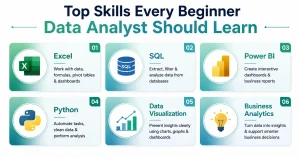
Here’s the honest priority order for someone starting from zero:
Tier 1 — Non-Negotiable (Learn These First)
SQL This is the single most important skill for any Data Analyst. Nearly every company stores data in a relational database, and SQL is how you access it. According to the Stack Overflow Developer Survey 2024, SQL is the most commonly used language among data professionals globally — ahead of Python. Learn SELECT, WHERE, GROUP BY, JOIN, subqueries, and window functions. There is no shortcut here.
Microsoft Excel Still widely used across Indian companies — especially mid-size firms, BFSI companies, and non-tech businesses. VLOOKUP, pivot tables, conditional formatting, data validation, and basic formula writing. Underestimating Excel is a common mistake freshers make.
Tier 2 — Core Job Skills (Learn These Second)
Power BI or Tableau These are the visualisation tools companies use to turn data into dashboards. Power BI is more widely adopted in Indian enterprises. Tableau has a strong presence in product companies. Learn at least one deeply — dashboard design, DAX basics (Power BI), filters, drill-through, and storytelling with data. Microsoft’s Power BI documentation is genuinely excellent and free.
Basic Statistics Mean, median, mode, standard deviation, correlation, basic probability. You don’t need a statistics degree. You need enough to understand what a trend means, when an anomaly is significant, and when a percentage change is actually meaningful vs noise.
Tier 3 — Competitive Differentiators (Learn These Third)
Python for Data Analysis Python with Pandas and Matplotlib. Not full programming — specifically data manipulation: cleaning datasets, merging files, exploratory analysis, and basic visualisation. In 2026, companies increasingly expect even analyst-level candidates to have basic Python. It’s the difference between getting shortlisted and getting overlooked for mid-level roles.
AI Tools for Analysts This is the gap almost no competitor blog covers. In 2026, Data Analysts are expected to know how to use AI tools — ChatGPT for writing SQL queries faster, Copilot in Power BI for suggesting visualisations, AI-assisted data cleaning tools. This doesn’t replace your skill — it makes you significantly faster. Training programmes that don’t include this are already behind.
For a deeper comparison of what separates a Data Analyst from a Data Scientist as you grow in this career, read our blog on Data Analyst vs Data Scientist — Which Career Is Better for You in 2026?
The Beginner Data Analyst Roadmap for Pune in 2026
Here is a realistic, month-by-month path — designed for someone starting with zero background.
Month 1 — Foundation (Excel + SQL)
Week 1–2: Excel
- Data entry, formatting, sorting, filtering
- Pivot tables — practice on any sales or HR dataset
- VLOOKUP, IF, COUNTIF, SUMIF formulas
- Basic charts: bar, line, pie
Week 3–4: SQL Fundamentals
- Install MySQL or use SQLiteOnline to practice in browser
- SELECT, WHERE, ORDER BY, LIMIT
- GROUP BY and aggregate functions (COUNT, SUM, AVG, MAX, MIN)
- Practice on free datasets from Kaggle
Month 1 goal: Complete one small project — analyse a sales dataset in Excel, answer 5 business questions using SQL.
Month 2 — Visualisation (Power BI + Advanced SQL)
Week 5–6: Power BI
- Connect to Excel and SQL data sources
- Build your first dashboard — 4 to 5 charts telling a story
- Learn DAX basics: calculated columns, measures, CALCULATE function
- Filters, slicers, drill-through, report publishing
Week 7–8: Intermediate SQL
- JOINs — INNER, LEFT, RIGHT
- Subqueries and CTEs (Common Table Expressions)
- Window functions — ROW_NUMBER, RANK, LAG, LEAD
- Practice on LeetCode SQL problems
Month 2 goal: Build a Power BI dashboard on a real dataset (ecommerce sales, HR data, or bank transactions). This becomes your first portfolio piece.
Month 3 — Python for Data Analysis
Week 9–10: Python Basics
- Data types, variables, loops, functions — just enough to work with data
- Pandas: reading CSV/Excel files, filtering rows, grouping, merging dataframes
- NumPy: basic array operations
Week 11–12: Exploratory Data Analysis (EDA)
- Matplotlib and Seaborn for visualisation
- Handling missing values and outliers
- Descriptive statistics in Python
- Build a full EDA notebook on a Kaggle dataset
Month 3 goal: One complete Python + Pandas analysis project, uploaded to GitHub with a written explanation of your findings.
Month 4 — Real Projects + Domain Understanding
This month is about depth, not new tools.
Pick one business domain that genuinely interests you — e-commerce, finance, healthcare, or marketing — and go deep. Build two complete projects in that domain. The goal is to have portfolio pieces that show business judgment, not just technical execution.
Project ideas:
- E-commerce: Customer segmentation by purchase behaviour + Power BI dashboard
- Finance: Monthly expense tracker and variance analysis using Excel + SQL
- HR Analytics: Employee attrition analysis in Python with visualisations
- Marketing: Campaign performance dashboard from Google Analytics export data
- IPL / Cricket Analytics: Analyse team performance, player statistics, or match outcomes across seasons — dataset is freely available on Kaggle, immediately familiar to Indian recruiters, and rich enough to demonstrate grouping, filtering, trend analysis, and visualisation all in one project. A strong choice specifically because the business context needs zero explanation in a Pune interview room.
Every project should answer a real business question, not just display data.
Month 5 — AI Tools + Advanced Visualisation
AI tools for analysts in 2026:
- Use ChatGPT/Gemini to write and debug SQL queries faster
- Microsoft Copilot in Power BI — automated insight suggestions
- Python AI libraries for anomaly detection in datasets
- Basics of prompt engineering for data tasks
Advanced Power BI:
- Row-level security
- Bookmarks and navigation buttons
- Publishing to Power BI Service
- Scheduled data refresh
Month 5 goal: Rebuild one of your earlier projects using AI tools to see where they help and where they still need human judgment. Document the difference—this is excellent interview material.
Month 6 — Placement Preparation
- Resume: List every tool, every project, and every business insight you generated. Quantify where possible — “Analysed 50,000 rows of sales data to identify ₹12L revenue gap” beats “worked with large datasets.”
- LinkedIn: Complete profile, featured section showing your Power BI dashboards and GitHub
- GitHub: All projects public, with README files explaining the business question and your approach
- Mock interviews: SQL query rounds, dashboard walkthroughs, case study questions, HR rounds
- Communication practice: Practice explaining your project to someone with zero data background. If they understand it, you’re ready.
See how USS students have turned this exact roadmap into real job placements at the USS Placement Page.
How to Build a Portfolio With Zero Work History
This is the section most beginners skip — and it’s the most important one.
Your portfolio is your proof. It replaces work experience entirely if it’s done well.
Where to get datasets:
- Kaggle.com — thousands of free, real-world datasets
- data.gov.in — Indian government open data (highly relevant for local context)
- Google Dataset Search — aggregates datasets from across the web
- Your own life — track your personal finances in Excel for 3 months, then analyse it. It’s real data and a great story.
What makes a portfolio project strong:
- It starts with a business question, not a tool demo
- The data required cleaning — show that process
- The insight is actionable — not just descriptive
- The visualisation is clean and designed for a non-technical reader
- There’s a written summary explaining what you found and what it means
What makes a portfolio project weak:
- Titanic dataset (every recruiter has seen 500 Titanic analyses)
- No business context — just charts without interpretation
- No README, no explanation, just raw code files
- Copy-pasted from a YouTube tutorial without modification
Three strong, well-documented projects beat ten generic tutorial replications. Every time.
Data Analyst Salary in Pune for Freshers in 2026
Let’s talk numbers—Pune-specific, because national averages are misleading.
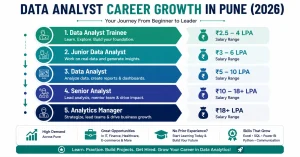
| Experience Level | Salary Range in Pune |
|---|---|
| Data Analyst Trainee (0–6 months) | ₹2.5 – ₹4 LPA |
| Junior Analyst / Fresher (6 months – 1 year) | ₹4 – ₹7 LPA |
| Mid-Level Analyst (2–4 years) | ₹8 – ₹15 LPA |
| Senior / Lead Analyst (5+ years) | ₹15 – ₹25 LPA |
A few honest notes on these numbers:
Domain specialisation moves salaries significantly. A Data Analyst with domain expertise in BFSI (banking, financial services, insurance) or healthcare consistently earns 20–30% more than a generalist at the same experience level. If you come from a finance or operations background, lean into that — it’s not a weakness, it’s a differentiator.
Tool depth matters more than tool breadth. A candidate who is genuinely strong in Power BI, SQL, and Python will out-earn someone who has surface-level knowledge of eight tools. Depth beats breadth in data analytics hiring.
Pune’s cost-of-living advantage is real. The same ₹7 LPA in Pune gives you meaningfully higher purchasing power than ₹7 LPA in Bangalore or Mumbai. Many Pune-based freshers find their quality of life superior to Bangalore counterparts earning slightly more.
According to salary data from AmbitionBox, Data Analyst roles in Pune have seen consistent year-on-year salary growth, with AI-adjacent analytics skills commanding the steepest premium in 2025–26.
What to Look for in a Data Analyst Course for Beginners in Pune
Not all data analytics courses in Pune are equal — and the differences matter significantly for beginners who have no frame of reference.
Here’s an honest evaluation framework:
Does the curriculum match 2026 hiring expectations?
A good data analyst course for beginners in Pune should cover:
- Excel → SQL → Power BI → Python (in that order)
- Real datasets and projects — not just textbook exercises
- AI tools integration — Copilot, ChatGPT for analytics tasks (most institutes still don’t teach this)
- Business communication and data storytelling — the skill that separates average from excellent analysts
- Statistics fundamentals — not deep, but enough to interpret data correctly
Is project work central — or optional?
This is non-negotiable. If projects are a “bonus” at the end of a course rather than integrated throughout — the curriculum is built for certification, not employment.
What does placement support actually include?
Be specific when asking:
- Is there a dedicated placement team (not just “we’ll forward your resume”)?
- How many mock interview rounds are included?
- What companies have last batch students been placed in?
- How long does placement support continue after course completion?
Are trainers currently working in the industry?
Academic trainers can teach tools. Industry practitioners teach you how tools are actually used in production environments — and that gap shows up very clearly in interviews.
Is flexible scheduling available?
Working professionals and college students need weekend and hybrid options. A good institute accommodates real life.
For the full framework on evaluating any training institute before enrolling, read our guide on how to choose the best software training institute in Pune.
Questions to Ask Before Joining Any Data Analytics Course
Most students don’t ask enough before enrolling. These are the questions worth asking every institute you visit:
- Can I see the actual syllabus — week by week?
- What projects will I build — and on what datasets?
- Do trainers have current industry experience or only teaching backgrounds?
- Does the course cover AI tools for analysts (Copilot, ChatGPT integration)?
- What does placement support include — specifically, not generally?
- Can I speak to a student from the previous batch?
- Is a free demo class available before I commit?
- What is the actual batch size? (Smaller = more attention)
- Is EMI or no-cost payment available?
If an institute hesitates or deflects on any of these — that’s information too.
Common Mistakes Beginners Make — And How to Avoid Them
These patterns show up consistently in beginners who struggle to get hired:
- Learning tools without building anything. Watching 40 hours of Power BI tutorials without building a single dashboard is the most common trap. The tool only becomes a skill when you use it on a problem you don’t already know the answer to.
- Starting with Python before SQL, Python feels exciting. SQL feels boring. But SQL is what companies test first in nearly every Data Analyst interview. Learn SQL deeply before moving to Python — not the other way around.
- Using only Titanic and Iris datasets, These are fine for learning mechanics. They’re terrible for portfolios. Recruiters have seen thousands of Titanic analyses. Find a dataset that’s relevant to the industry you want to work in.
- Ignoring data storytelling Technical skills get you in the room. Communication skills get you the offer. Practice explaining your analysis to someone non-technical. If they don’t understand it, the work isn’t done yet.
- Treating certification as the goal, A certificate proves you completed a course. A portfolio proves you can do the job. In 2026, Pune recruiters care about the second one — not the first.
- Skipping mock interviews the first time you explain your project shouldn’t be in a real interview. Do multiple mock rounds before going live. Stumbling through your own project in an interview is a recoverable mistake you can avoid entirely.
- Waiting until “everything is perfect” before applying. This quietly kills more careers than any skill gap does. You will never feel 100% ready — and that feeling doesn’t go away with one more tutorial or one more certificate. Apply when you have 3 solid projects and can explain your work clearly. The interview process itself teaches you more than another month of preparation ever will. Start before you feel ready. Feedback from real interviews is irreplaceable.
Still deciding between self-learning via YouTube and structured training? Our honest breakdown in YouTube vs. Live IT Training explains exactly where each approach works — and where it doesn’t.
How Unique System Skills India Prepares Beginners for Real Jobs
Unique System Skills India is a Pune-based training institute rated 4.7/5 by over 1,000 students — with a Data Analytics with AI programme specifically designed for beginners with no prior experience.
Here’s what the programme covers, transparently:
Curriculum built for 2026 hiring: Excel → SQL → Power BI → Python (Pandas, NumPy, Matplotlib) → Statistics → AI Tools for Analytics → Data Storytelling → Placement Preparation. Structured in the exact order that builds skills logically, not randomly.
AI tools included — not as an add-on: ChatGPT for SQL and analysis tasks, Microsoft Copilot in Power BI, AI-assisted data cleaning. Students learn how to use AI as a productivity multiplier — which is what 2026 employers are increasingly testing for.
Project-based from week one: Real datasets. Real business questions. Projects in e-commerce, BFSI, healthcare, and marketing domains. By graduation, students have 4–5 portfolio projects they can present confidently in interviews.
Industry-experienced trainers: All trainers have worked in enterprise analytics environments — not just taught about them. The difference shows in the quality of interview preparation.
Genuine placement support:
- Dedicated placement team
- Resume building and LinkedIn profile optimisation
- Multiple mock technical and HR interview rounds
- Company referrals to Pune-based IT and analytics firms
- Post-course placement support — not just during the batch
Flexible learning: Online + Classroom (Hybrid), Weekday and Weekend batches. Suitable for college students, working professionals, and freshers.
Recognised certification: NSDC (NSDCL) certification included — globally recognised, not just a PDF with a logo.
No-cost EMI is available — so financial constraints don’t block a career decision.
Frequently Asked Questions
Can I become a Data Analyst in Pune without a coding background? Yes. SQL is required and is learnable from scratch in 4–6 weeks. Python basics are needed for mid-level roles but can be learned after core tools. Many successful Data Analysts in Pune come from commerce, BBA, and arts backgrounds.
How long does it take to become a Data Analyst from scratch in Pune? Most beginners become interview-ready in 4–6 months with consistent, structured training and active project work. Passive learning without projects takes significantly longer and often doesn’t result in placement.
What is the salary of a fresher Data Analyst in Pune? Freshers typically earn ₹4–7 LPA in Pune. Domain specialisation and strong project portfolios push this toward the upper end.
Is a data analyst course for beginners in Pune expensive? Course fees in Pune typically range from ₹25,000 to ₹80,000 depending on depth, duration, and placement support. Unique System Skills India offers No-Cost EMI options. Always evaluate value — not just price.
Do I need a maths or statistics background for data analytics? No. School-level maths is sufficient. The statistics needed for analyst roles (averages, percentages, correlation basics) are taught within any good data analytics course.
Is Power BI or Tableau better to learn first? Power BI is more widely used in Indian enterprises and has a faster learning curve. Learn Power BI first unless you’re specifically targeting companies that use Tableau (more common in US-facing product companies).
Can a working professional switch to Data Analytics from a non-IT job? Yes — and domain experience is a genuine advantage. A finance professional with SQL and Power BI skills is a highly valuable hire for BFSI analytics teams. Weekend batch options make the transition feasible without leaving your current job.
What is the scope of Data Analytics in Pune specifically? Pune has strong demand from BFSI companies, IT services firms, manufacturing companies doing Industry 4.0 analytics, healthcare, and e-commerce. According to NASSCOM, data analytics roles are among the fastest-growing job categories in India’s IT sector, with Pune in the top five cities for data hiring.
Will AI replace Data Analysts? No — but it’s changing the role. AI automates basic reporting. It doesn’t replace business judgment, critical thinking, or the ability to ask the right question. Analysts who learn to use AI tools as productivity multipliers are more valuable in 2026, not less. For a deeper look at this, read our blog on The Rise of AI and Machine Learning.
How is Data Analytics different from Data Science? Data Analytics focuses on interpreting existing data for business insights. Data Science builds predictive models using machine learning. Analytics is the more accessible entry point for beginners. For a full comparison, see our guide on Data Analyst vs Data Scientist — Which Career Is Better for You in 2026?
Book Your Free Demo Class
If you’ve read this far, you know the path is real. The tools are learnable. The jobs are there. The question now isn’t whether this is possible — it’s whether you’re going to start.
The one thing that separates people who make this transition from those who keep researching it indefinitely is a first concrete step.
At Unique System Skills India, that step is a free demo class. Come in, meet the trainers, see how the teaching actually works, evaluate whether the curriculum matches what you’ve read here. No commitment. No sales pressure. One session — and you’ll know.
Zero experience needed. Start from scratch. Get job-ready in 6 months.
📞 Call / WhatsApp: +91 9970666888
🌐 www.systemskills.in